
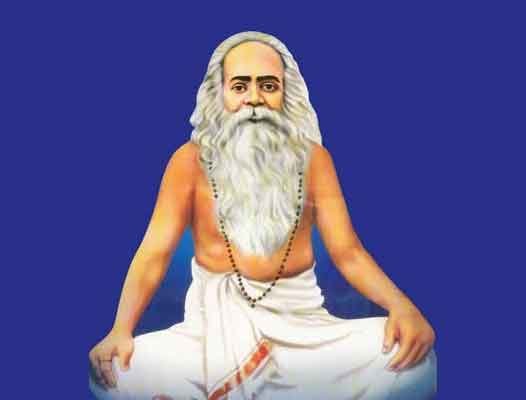
At a glance
Born: 1853, Kollur, Thiruvananthapuram
Maha Samadhi: 5 May 1924, Panmana, Kollam
Also known as: Ayyappan, Kunjan Pillai, Shanmukhadasan
Guru of: Sree Narayana Guru
Sree Vidyadhiraja Parama Bhattaraka Theerthapada Chattampi Swamikal
Sree Vidyadhiraja Parama Bhattaraka Theerthapada Chattampi Swamikal (1853–1924) was a Hindu sage and social reformer. Swamikal, along with his primary shishya Narayana Guru, strived to reform the heavily ritualistic and caste-ridden Hindu society of late 19th century Kerala.
Chattampi Swamikal denounced the orthodox interpretation of Hindu texts, citing sources from the Vedas. Swamikal also worked for the emancipation of women and encouraged them to come to the forefront of society. He said that the enslavement of women was a manifestation of male arrogance. Swamikal promoted vegetarianism and professed non-violence (Ahimsa). He authored several books on religion, spirituality and the history of language.
Chattampi Swamikal was known by different names throughout his intellectually and spiritually enriched life. The Swami's original name was Ayyappan, although he was called Kunjan Pillai and later Shanmukhadasan.
Early life
The Swami's father was Vasudeva Sharma, a Nampoothiri from Mavelikkara, and his mother Nangamma Pillai, a lady from Kollur, a suburban village of Trivandrum in southern Travancore. In childhood his name was Ayyappan Pillai, or Kunjan Pillai.
He joined the traditional school conducted by Pettayil Raman Pillai Asan, a renowned scholar and writer. It was there that he earned the name Chattampi on account of his assignment as the monitor of the class. The young Kunjan Pillai was introduced to the science of yoga by the guru Thykattu Ayyavu, whom he met at the Gurukulam. Kunjan Pillai was also called Shanmukhadasan due to his deep devotion to Lord Subramanya.
It is said that in his youth Kunjan Pillai took to manual labour as a brick worker and later worked as a document writer in Neyyattinkara town, near Thiruvananthapuram. After becoming a saint, Swamikal received the darshan of Chettikulangara Devi while he was at Mavelikkara.
Guru of Sree Narayana Guru
It was in 1882 at the Aniyoor Temple near Vamanapuram that Chattampi Swami first met the young Nanu Asan. By then Kunjan Pillai was well versed in yoga and spiritual matters, and their meeting proved to be the start of a profound and cherished relationship, although the two were of different temperaments. In those days Nanu Asan was a soft-spoken introvert while Kunjan Pillai was an outspoken extrovert. Swamikal took Nanu Asan, who was in search of a mentor, as his disciple.
Later Chattampi Swamikal and Nanu Asan travelled together to many places in quest of truth and spiritual knowledge. It was with Chattampi Swamikal that Narayana Guru made his first trip to Aruvippuram, which was chosen as Narayana Guru's abode for meditation and spiritual activities. Chattampi Swamikal, however, did not stay there for long, although the two maintained their contacts, respect and regard for each other.
Chattampi Swamikal had many disciples — grihastha disciples such as Bodheswaran, Perunnelli Krishnan Vaidyan and Velutheri Kesavan Vaidyan, as well as sanyasi disciples such as Narayana Guru, Neelakanta Theerthapada and Theerthapada Paramahamsa, who all played a very important role in the renaissance and reformation of Kerala.
Maha Samadhi
Toward the end of his life, Swamikal settled down at Panmana, a village in Kollam district. Swamikal attained Maha Samadhi on 5 May 1924. His mortal remains were enshrined at his Samadhistanam at Panmana, which remains a place of pilgrimage today.